Material screening
Identify substrate, coating, fillers, adhesive, thickness, and any supplier safety document. Unknown PVC, halogenated stock, and materials with uncertain decomposition products stay outside the test queue until reviewed.
A laser purchase is one part of a working cell. The remaining questions concern material safety, artwork preparation, focus, fixture repeatability, extraction, and the evidence needed before an operator releases a batch.
The rail separates decisions that are often mixed together. Scroll horizontally on smaller screens; every card describes a distinct handoff artifact.
Identify substrate, coating, fillers, adhesive, thickness, and any supplier safety document. Unknown PVC, halogenated stock, and materials with uncertain decomposition products stay outside the test queue until reviewed.
Check vector closure, raster density, minimum text, datum strategy, part-to-part variation, and clearance for clamps or rotary tooling. The result is a file-and-fixture checklist, not a generic promise.
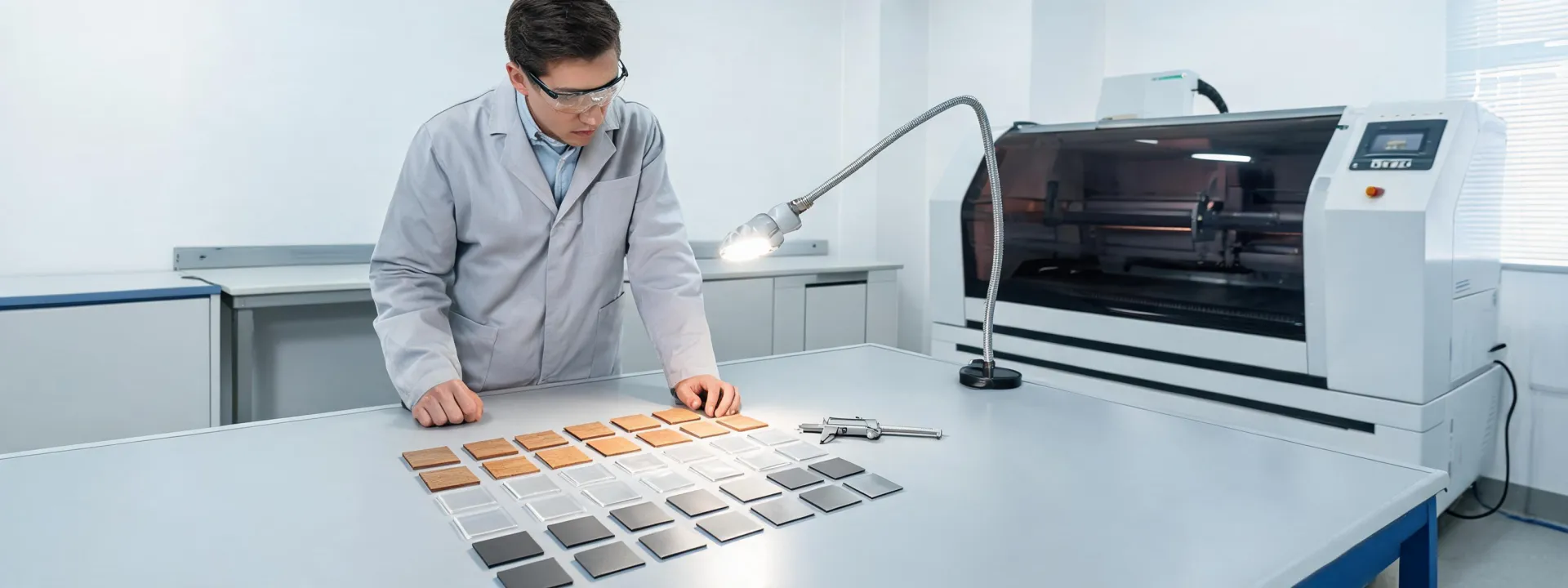
Run a bounded matrix across power, speed, frequency or pulses-per-inch, focus offset, and air assist. Record the optical state and exhaust condition so a later operator can reproduce the approved coupon.
Define inspection points, lens and mirror cleaning intervals, exhaust checks, first-piece acceptance, and change-control triggers. A different material lot or coating calls for revalidation.
These counts describe the recommended review framework—not guaranteed production outcomes. Actual cycle time and finish remain dependent on the selected system, material, geometry, optics, ventilation, and operator procedure.
For a reproducible trial, retain the coupon, source file revision, machine configuration, lens identification, focus method, environmental notes, and the approved parameter range. Photograph the result under consistent lighting and note the inspection distance.
Describe the material, coating, largest part, smallest feature, artwork format, expected quantity, finish target, and ventilation constraints. Application work begins with the unknowns made visible.